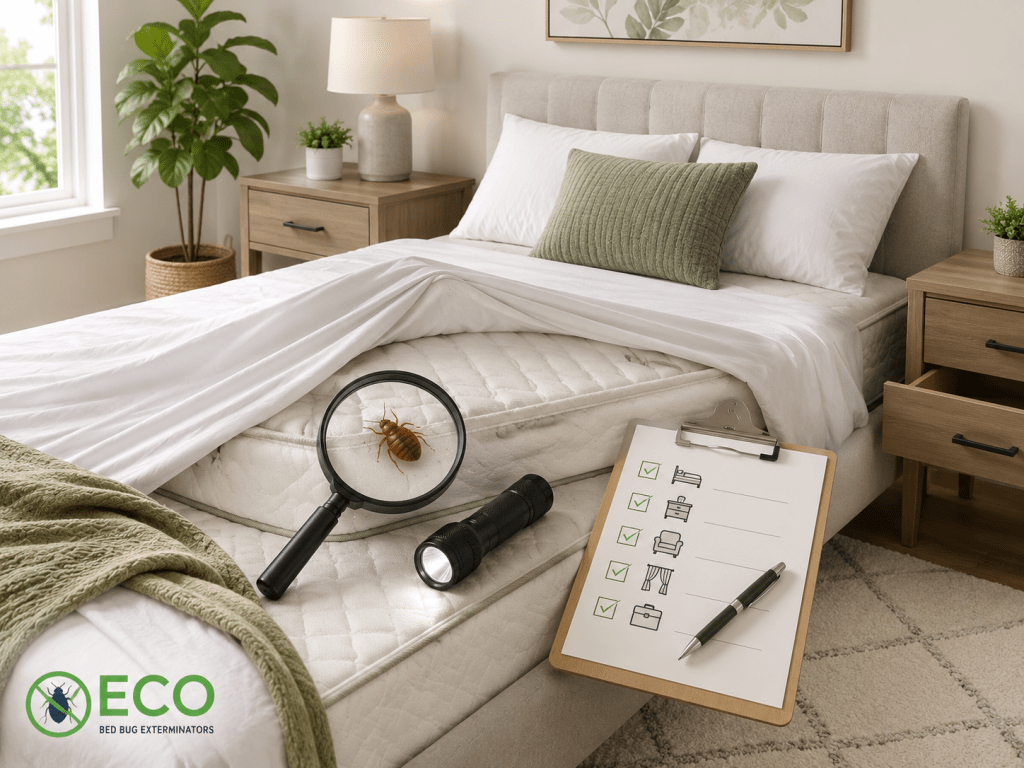

How To Avoid Bed Bugs This Thanksgiving

Thanksgiving is almost here, and we all know how stressful it can be to get ready for the big day.  For many homeowners, this means traveling to visit their loved ones and all of the hassles associated with it. The last thing on your mind is bed bugs and unfortunately, humans aren’t the only species that do a lot of traveling around the holiday.

Bed bugs will be taking the opportunity to catch a ride on the nearest suitcase, piece of clothing, or handbag. So after leaving the family, and traveling back home, bed bugs could be hitching a ride.  It’s important to keep an eye out for these bugs. If you don’t, you could face an unwanted infestation when you get home. Unfortunately, bed bugs won’t just stop in for a friendly visit. Just one bed bug getting inside your home could be the beginning of a stressful infestation.

Important tips for you while keeping the risk of bed bugs to an absolute minimum:

  • Do research on hotels, motels, and inns before you reserve your sleeping accommodations to make sure reviews don’t mention bed bugs.
  • At hotels, pull back the sheets and inspect the mattress seams, particularly at the corners, for telltale stains or spots.  If you see anything suspect, notify management and change rooms/establishments immediately.
  • Thoroughly inspect the entire room before unpacking, including behind the headboard and in sofas/chairs.  If any pests are spotted, change rooms/establishments immediately.
  • If you do need to change rooms, be sure that you do not move to a room adjacent and/or directly above/below the suspected infestation.  Bed bugs can easily hitchhike via housekeeping carts, luggage and even through wall sockets. If an infestation is spreading, it typically does so in the rooms closest to the origin.
  • Pack your clothing in airtight plastic bags within your suitcase.  Take along extra airtight bags for things you buy or for dirty laundry.
  • Consider placing your suitcase in a plastic trash bag or protective cover during the duration of your trip to ensure that bed bugs cannot take up residence there prior to departure.
  • Watch for bed bugs in taxis, rideshare, buses, trains, and planes, especially on headrests.

Think you may have brought bed bugs home?

If you do come in contact with a bed bug infestation during your travels, it can be very hard to prevent them from infesting your house. Follow these steps after returning to decrease the chances of an infestation:

  • Carefully examine the suitcase for bed bugs and other signs. Pay close attention to zippers and creases as they like to hide there.
  • Remember: bed bugs travel by hitching rides. After your trip, inspect your suitcases before bringing them into the house. Store luggage in the garage our until you have the opportunity to examine them. Vacuum your suitcase thoroughly before storing away. Consider using a garment hand steamer to steam your luggage, which will kill any bed bugs or eggs that may have hitched a ride home.
  • Wash all of your clothes – even those that have not been worn – in hot water to ensure that any bed bugs that may have made it that far are not placed into your drawers/closet.
  • Contact pest professionals for an inspection if you begin seeing signs of an infestation.

We know from experience that bed bugs are hard to get rid of and a horrible experience for people everywhere. We offer a comprehensive bed bug control service that allows us to quickly identify an infestation. Our effective heat treatment technology gets rid of all of those developmental stages of bed bugs and it is eco-friendly. If you have bed bug problems in your home, ECO Bed Bug Exterminators Baltimore has the solution. Give us a call today at (410) 324-6223 and ask about our bed bug solutions.

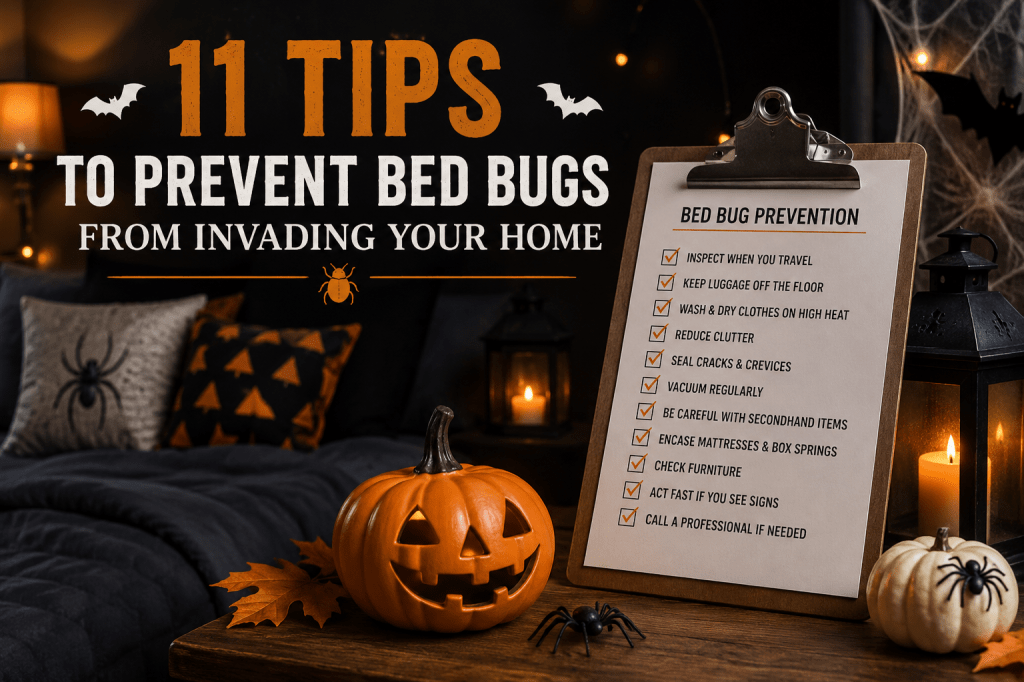
11 Tips To Prevent bed bugs From Invading Your HomE

Halloween is filled with everything spooky, scary, and a little bit creepy. And while we love to decorate the last thing you want is to find the real things lurking around your home. The name “bed bug” is slightly deceiving, as this creature can be found in more places than just between the sheets. 

Despite what their name implies, their flattened bodies also allow them to conceal themselves in cracks and crevices around the room, such as in floorboards, skirting boards, or within furniture. However, they usually tend to stay close to anywhere you or a pet will be sleeping – which is why over a third (35%) of them are found in the box springs of a mattress, 23% are found in the mattress itself and 13% are found in the bed frame or headboard.  It will travel within your home looking for you, or some other warm blooded animal, on which to feed. 

1. Don’t Store Items Under Your Bed

Storing items under your bed creates opportunities for bed bugs to hide near your mattress. You may also unknowingly store an infested item. 

2. Store Items in Plastic Containers

Bed bugs find it difficult to crawl on smooth surfaces such as glass or plastic. Keeping your storage items in a plastic container or plastic bag helps to prevent spreading. 

3. Remove Clutter From the Floor

Keep your clothes off the floor. If a wandering bed bug happens to latch onto your sweater, you run the risk of infecting your dresser or closet.  Plus, clutter increases the difficulty in eliminating bed bugs once they’ve been established. 

4. Dust Mite-Proof Encasements

Cover your mattress or box spring in dust mite-proof encasements to create a barrier between you and any potential bed bugs.  Plus, if you do have bed bugs, an encasement will trap the bed bugs and they will die of starvation. 

5. Vacuum Regularly

This prevention method helps you remove stray bed bugs.  Make sure to hoover all hiding hotspots, such as dust ruffles, under sofa cushions and under the bed.  For further prevention, dispose of the vacuum bag in an outside trash can. 

6. Keep Clothes off the Bed

You don’t know whose bed these bugs have infested and whose bed they haven’t. It’s best to keep your clothes off any beds if you want to prevent bed bugs from coming into your home. With that in mind, keep other people’s clothes off your bed. You never know if they may be transporting a bed bug from their home. Instead of placing guests’ coats on your bed, hang them in the coat closet. 

7. Inspect your Lodging Area

Before unpacking your clothes in your new sleeping arrangements, such as a hotel, motel, or dorm room, inspect the space. Check curtains, the carpet, the walls, and surrounding areas for any signs of bed bugs. Most importantly, check the bed for any signs. If you spot a potential infestation, ask for another room. Avoid placing your clothes on the bed. 

8. Wash Clothes and Luggage After Traveling

Ensure your travels don’t bring home a bed bug. Immediately wash your clothes and clean any luggage, including suitcases, backpacks, and purses.  If you share laundry facilities with others, such as in apartment complex, laundromats, student accommodation, take extra caution. When you transport your items to be washed, keep them in a plastic bag and once they are washed, remove them from the dryer and place them straight back in the bag. Fold them at home where it’s safer to do so. 

9. Wash Sheets on the Highest Setting

About once a week, wash your bed linens at the highest temperature. The heat can help kill bed bugs and their eggs. 

10. Avoid Taking Furniture From Curbs or Dumpsters

A free couch on the side of the road can be tempting. But bringing it into your home can lead to a grave bed bug infestation. Avoid taking any furniture from curbs or dumpsters, as bed bugs may have infested them. 

11. Keep Your Bed Sheets off the Ground

When making your bed or sleeping, make sure your sheets are not touching the floor. A hanging sheet allows a wandering bed bug to crawl up to your bed.

CAN MY CHILD BRING BED BUGS FROM SCHOOL

What are Bed Bugs?

Bed bugs are small, reddish-brown, parasitic oval-shaped insects roughly the size of an apple seed. They are most active at night, and they feed on blood. When they’re inside a home, they can be attracted to sleeping humans by cues such as carbon dioxide and body heat.  They may emerge from their resting spots under mattresses, around headboards or in furniture to find their next meal, sometimes leaving small bites, which may resemble mosquito or flea bites. Generally, bed bugs feed every 5 to 10 days.

Bed bugs doesn’t just infest houses and hotel rooms, they can make a home almost anywhere, including daycares, schools and colleges. Bed bugs are great hitchhikers, so how can you help keep your kids from bringing them home? Read on to learn more about bed bugs and some important bed bug prevention tips.

How do you keep bed bugs from coming home from school?

  • Upon returning home from school, check your kid’s backpacks, jackets and clothing and keeping these items in a separate area of the house.
  • Keep backpacks in plastic bags or closed storage bins. At minimum, do not leave backpacks in or near bedrooms.
  • If bed bugs have been found at their school, have children disrobe immediately upon coming home, and place clothing in sealed plastic bags.
  • Place clothing in a dryer (medium-high heat for 30-45 minutes) and throw out the plastic bag. Bed bugs can’t survive high heat.
  • Engage the school administration. Ask them what precautionary and proactive measures they are taking to prevent the introduction and spread of bed bugs.

Call the Professionals

Treating bed bugs is not something you want to do yourself. It can be costly and ineffective, and bed bugs are notoriously difficult to get rid of.  If bed bugs have found their way into your home, or you think they might have, call ECO Bed Bug Exterminators at 410-324-6223 to get an inspection and a customized treatment plan.

How to Treat Bed Bug Bites

It can be difficult to distinguish bed bug bites from other insect bites or rashes. In general, the sites of bed bug bites usually are:

1. Red, often with a darker red spot in the middle

2Itchy

3. Arranged in a rough line or in a cluster

4. Located on the face, neck, arms and hands. Some people have no reaction to bed bug bites, while others experience an allergic reaction that can include severe itching, blisters or hives.

At-Home and OTC Treatments for Bed Bugs

For the bed bug bites themselves, there are a few steps you can take to soothe the itch and prevent them from becoming infected:

1. Don’t scratch them. Scratching can cause them to be inflamed and you run the risk of an infection and can sometimes leave a dark mark on skin that you might not want there.

2. Use ice packs several times a day to soothe the bites and help take the itchy sensation away.

3. Moisturize the affected skin. Moisturizing can have a cooling effect, which also should help cut down on itching.

4. Use over-the counter topical creams or products that can help address itching. These can include products with:

— Antihistamines.

— Calamine lotion.

— Colloidal oatmeal.

— Hydrocortisone 1%.

— Lanolin, but not if you’re allergic to it.

— Sarna, a cream that contains camphor and menthol in its original formula.

These products work best when applied to damp skin. Usually, the bites will go away after a week or two.

When to See a Doctor for Bed Bug Bites

Most bed bug bites require no medical treatment. Talk to your doctor if you experience an allergic reaction to the bites or if you develop swollen red skin with hives, they are oozing puss or a skin infection after scratching the bites.

Doctors often will use a prescription-strength steroid cream for bug bites or an antibiotic if there’s an infection.

Baltimore Among Top Cities For Bed Bugs In 2021 List

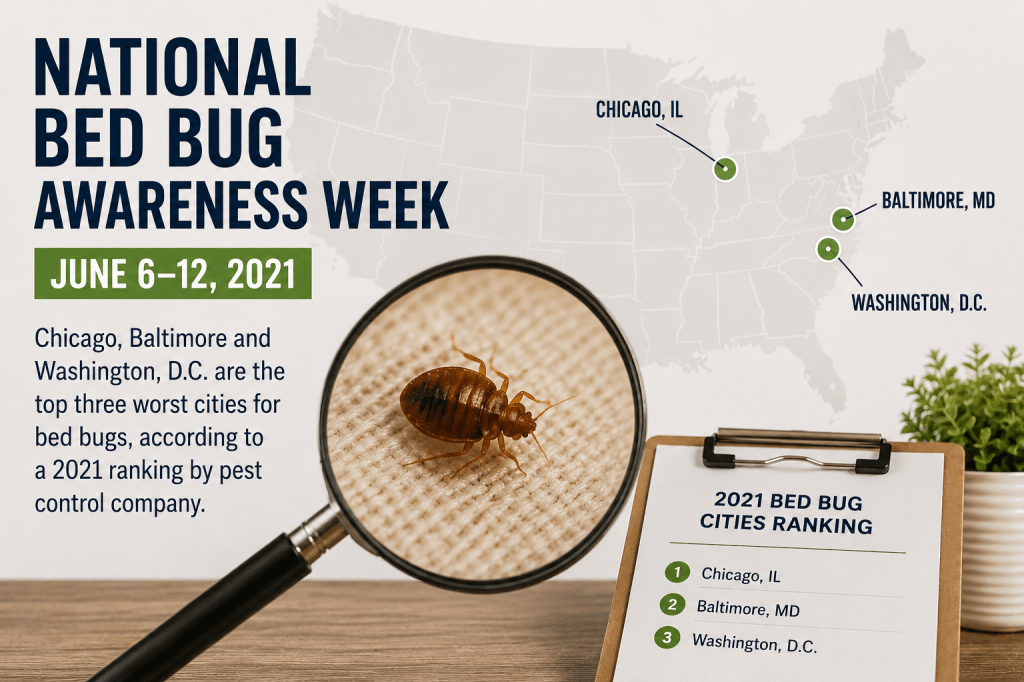
National Bed Bug Awareness Week 2021 is June 6-12. Chicago, Baltimore and Washington, D.C. are the top three worst cities for bed bugs, according to a 2021 ranking by pest control company Orkin. (Shutterstock)

Chicago, Baltimore and Washington, D.C. are the top three worst cities for bed bugs, according to a 2021 ranking by pest control company Orkin.

ACROSS AMERICA — Most U.S. cities can claim bragging rights for at least a few things. Maybe it has good schools or a lively music scene. Maybe the city is rich in history or has a booming economy. Perhaps it’s just a great place to live.

One thing you probably don’t associate with your city? Bed bugs. Turns out these tiny hitchhiking pests are quite fond of our city, according to the latest numbers available through Atlanta-based Orkin, a company that specializes in pest control services.

In fact, Baltimore ranked second on the 2021 list for the second year in a row, according to Orkin.

Cities were ranked according to where Orkin performed the most bed bug treatments between Dec. 1, 2019, and Nov. 30, 2020. The ranking includes both residential and commercial treatments.

1. Chicago, Illinois
2. Baltimore, Maryland
3. Washington, D.C.
4. Detroit, Michigan
5. Columbus, Ohio
6. Cleveland, Ohio
7. Indianapolis, Indiana
8. Cincinnati, Ohio
9. Los Angeles, California
10. Grand Rapids, Michigan

See the full list of top cities for bed bugs.

So, why share this creepy crawly revelation now?

In just a few days, the National Pest Management Association kicks off Bed Bug Awareness Week, which runs June 6-12. The goal of the campaign is to help people recognize a bed bug infestation and know how to curb it.

Also, the number of people itching to travel is growing as more Americans become vaccinated against COVID-19.

Over Memorial Day weekend, the Transportation Security Administration screened about 7.1 million people at U.S. airport checkpoints. On Sunday, about 1.9 million people traveled — eight times more than on the same day in 2020.

Since bed bugs are widely associated with travel, people must stay vigilant, according to Cindy Mannes, executive director of the Professional Pest Management Alliance — especially after months of coronavirus-related restrictions and lockdowns.

“Bed bugs can survive for several months without a blood meal and could be hungry if they have survived unnoticed after decreased travel amid the pandemic,” Mannes said in a news release.

What is a bed bug? These insects are tiny in size — just under a quarter-inch long, according to Orkin. They’re usually dark brown or red in color and are hematophagous, meaning blood is their only food source. Bed bugs take blood meals from sleeping humans and can travel from place to place with ease, stowing away in things such as luggage, purses and other personal belongings.

If you plan to travel this summer, there are a few things you can do to prevent bed bugs from coming home with you. Orkin recommends people follow the “SLEEP” method to crack down on possible bed bug infestations:

S: Survey the room for signs of an infestation. Be on the lookout for tiny, black, ink-colored stains on mattress seams, in soft furniture and behind headboards. Bed bugs can even hide out in electrical outlets and picture frames.

L: Lift and look in bed bug hiding spots: the mattress, box spring and other furniture, as well as behind baseboards, pictures and even torn wallpaper.

E: Elevate luggage away from the bed and wall. The safest places are in the bathroom or on counters.

E: Examine your luggage carefully while repacking and once you return home from a trip. Always store luggage away from the bed. Be sure to also examine all secondhand furniture and clothing before bringing it in your home and inspect after guests visit.

P: Place all dryer-safe clothing from your luggage in the dryer for at least 45 minutes at the highest setting after you return home.

If you need more guidance on eliminating bed bugs from your home, the Environmental Protection Agency has a step-by-step guide for evaluating and treating the infestation.

— By Megan VerHelst and Elizabeth Janney to see article: Got Bed Bugs? Orkin Ranks 2021’s Top Cities For Bed Bugs | Across America, US Patch

YOU’RE MOVING AND YOU DON’T WANT TO BRING BED BUGS INTO YOUR HOME?

So you’re excited about moving to a new place. If you’ve dealt with bed bugs in the past, you definitely don’t want to move any bed bugs or eggs into your new home and face a repeat of that scenario. How can you be sure the home you are moving to has no bed bugs? There are some precautions you can take to make sure your new home is free of these pests.

HOW TO PREVENT THEM

  1. If you ever had bed bugs in your current home, hire an exterminator to eliminate them. Follow the advice about cleaning and packing your clothes and other items for treatment. Wash or dry clean all cleanable items before packing.
  2. Find out if your new place has ever had a bed bug infestation. For an apartment, ask if any of the units in the building have had bed bugs in the last year. Do the same for a townhouse or single family home.  Ask for a disclosure in writing.
  3. For apartments or rentals ask about the landlord’s policies regarding a bed bug infestation. Who is responsible for paying for treatment if bed bugs are found, landlord or resident?
  4. The best way to know if your space is free of bed bugs is by having a professional inspection done.  This service is also a much cheaper decision in the long run rather than having to deal with problems in the future. If you do see bed bugs, discuss control measures with the landlord or previous homeowner and make sure the place is certified bed bug-free before you move in.

MAKING THE MOVE

  1. Use new boxes and packing materials whenever possible. If you must re-use boxes, check them for bed bugs first.
  2. If you have hired someone to move your belongings, remember that some moving companies take precautions against bed bugs while others don’t.  Ask anyone that you hire for moving purposes what their bed bug policy is and if they can guarantee that the trucks they use are free of bed bugs. Do they check and clean vehicles between jobs? Do they use new boxes and clean blanket pads for each job? Be careful when you are using people who are not professional movers.  Also, do the same when renting a moving truck.  If you’re packing your own rental van, check it before you load up.
  3. If you are storing items before the actual move, ask the same kinds of questions of the storage facility. How often do they check for bed bugs? Check the storage unit before you fill it and check your items carefully when you remove them.
  4. If you’re getting rid of any bed bug-infested mattresses, furniture, or other items, follow proper procedures to make sure that you don’t pass the infestation on to someone else.

The importance of checking for bed bugs when you first move in cannot be overemphasized. A single female lays multiple eggs daily, which can quickly lead to a major infestation in a matter of months.

Bed bugs are tough to see; you are looking for an insect roughly the size of an apple seed. Contact us for your inspection needs. We offer visual and canine inspections for bed bug detection.

MY MOTHER’S CAREGIVER WAS THE REASON SHE GOT BED BUGS

Difficult as it is to consider, they may one day need our help — just as we once needed theirs.  Having a caregiver to help care for them is a great source that can provide you with peace of mind. Caregivers can help provide assistance in everyday activities such as eating, bathing, and dressing in addition to ensuring that the proper medications are administered, and doctor appointments are kept.

Unfortunately, one of the main reasons people get bed bugs is because of a caregiver or a family member that has them. So what do you do when your caregiver is no longer a relief, but the reason the stress is occurring?

The Awkward Bed Bug Conversation

It’s important to note that people can get bed bugs from anywhere and anyone can get them. They are resilient pests that are famously known for hitchhiking their way from victim to victim. So before you start pointing fingers it is important to be open minded before beginning the conversation and be sure that you do indeed have bed bugs.

First step is to call a professional bed bug exterminator, like ECO Baltimore, for an inspection. We will give you our expert opinion as to whether you have bed bugs or not. If you have a bed bug infestation, it is important to tell those that enter and leave your home on a regular basis. You do not want your caregivers or family member spreading it to their homes.

Depending on how bad the infestation is at your home, it may have already spread to their residences. If your infestation was just beginning to start, it is likely that you were not the original source of the bed bugs. If you believe that your bed bugs may have come from your caregiver or family member’s homes, it is vital to suggest they get an inspection done as well. Even if you do not believe it came from their home, it would be the polite manner to suggest they get one done.

How Did They Bring Bed Bugs Into My Home?

Bed bugs are known for being excellent hitchhikers. Using people’s belongings such as clothes, purses, and luggage. They even travel on a person’s shoes!

Caregivers are consistently rotating through people’s homes, therefore having a higher chance of picking up a bed bug or two. This then leads to them bringing them to their own homes and spreading them to others. This is especially true for caregivers or housekeepers that assist the elderly, in truly opposite formats.

While cleaning, a housekeeper is turning up furniture and digging around in areas that are not typically addresses, aka where bed bugs hide. This can lead them to collect a few on their belongings or clothes.

A caregiver, or someone who assists the elderly or disabled in their home, can pick up bed bugs due to the lack of attention done to prevent bed bugs. Those that do not have the means to clean on a consistent basis or discard clutter can find themselves living with bed bugs for years and not even know it.

How Do I Stop It From Happening?

You cannot simply avoid bed bugs or completely prevent them from coming into your home. They are only the size of an appleseed, quick, and have no preferences of their own. We would drive ourselves crazy constantly checking ourselves for bed bugs and that is no way to live.

There are a couple of simple things you can do to reduce your chances of bringing bed bugs into your home:

  • Get a mattress and box spring cover with no seams
  • If you consistently rotate homes, like a babysitter or housekeeper, be sure to spray your shoes down with 91% alcohol as soon as you leave a residence
  • If you are a caregiver or housekeeper, be sure to put your clothes in the wash right away when you get home. Use hot water and high heat!
  • Avoid upholstered communal areas, like couches in a motel lobby.
  • Inspect your home mattress regularly
  • Inspect any bed you plan to sleep on (hotel, motel, guest room bed, etc.)
  • Have an open conversation with your caregiver or housekeeper about letting you know if they ever have a bed bug issue

If you feel as though you were in a home with bed bugs or your caregiver, housekeeper or a babysitter might have them call ECO Baltimore Bed Bug Exterminators today to schedule YOUR inspection at (410) 929-3420 or visit us on our website.

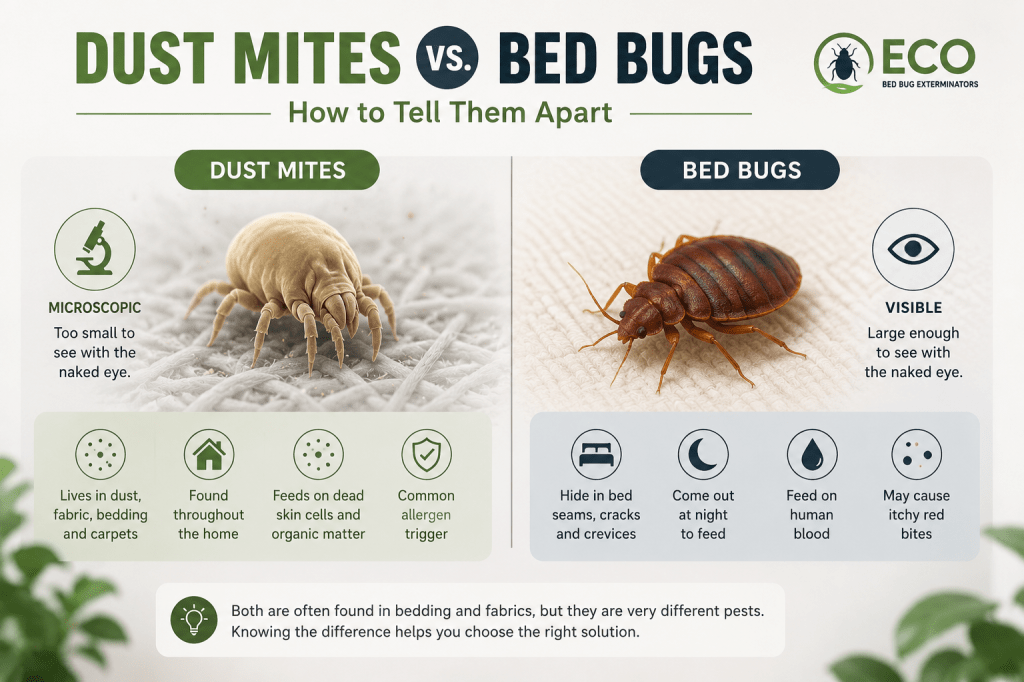
Dust Mites vs. Bed Bugs – How To Tell Them Apart?

Dust Mites vs. Bed Bugs – How To Tell Them Apart?

Bed bugs and dust mites belong to different groups of pests that infest our household and cause various health issues. Where bed bugs are typically the size of an apple seed and are easily discernible to the naked eye, dust mites are microscopic.  Bed bugs are small, oval insects that do not fly and can live anywhere in the home. These pesky pests take up residence in various areas of the home, including cracks in furniture, in any type of textile and most commonly, in beds, where they thrive in the mattress, box springs and bed frames.

Bed bugs are parasites that feed on blood of humans and pets (mammals) but dust mites do not actually feed on humans and pets. Bed bugs are insects and dust mites belong to the arachnids (spider) family. Diseases caused by dust mites are mainly due to the chemical composition of their shed skin and feces. Let’s look at the differences between bed bugs and dust mites.

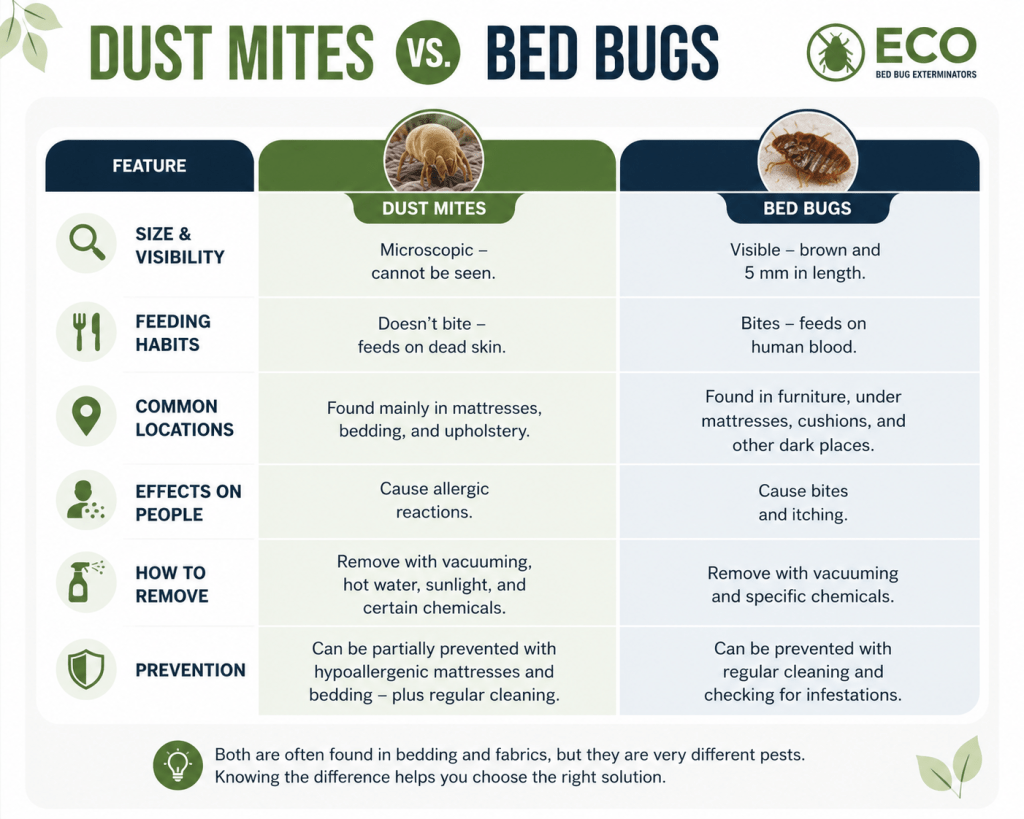
Dust MitesBed Bugs
Microscopic – cannot be seen.Visible – brown and 5 mm in length.
Doesn’t bite – feeds on dead skin.Bites – feeds on human blood.
Found mainly in mattresses, bedding, and upholstery.Found in furniture, under mattresses, cushions, and other dark places.
Cause allergic reactions.Cause bites and itching.
Remove with vacuuming, hot water, sunlight, and certain chemicals.Remove with vacuuming and specific chemicals.
Can be partially prevented with hypoallergenic mattresses and bedding – plus regular cleaning.Can be prevented with regular cleaning and checking for infestations.

Symptoms of Dust Mites

Dust mite allergy symptoms caused by inflammation of nasal passages include:

  • Sneezing
  • Runny nose
  • Itchy, red or watery eyes
  • Nasal congestion
  • Itchy nose, roof of mouth or throat
  • Postnasal drip
  • Cough
  • Facial pressure and pain
  • Swollen, blue-colored skin under your eyes
  • In a child, frequent upward rubbing of the nose

Dust mite vs. bed bug bites:

Where bed bug bites are real and cause discomfort that can be easily diagnosed, dust mites may not be easily diagnosed due to lack of awareness. Dust mites are potentially more dangerous than bed bugs because they adversely affect people and children who are susceptible to allergies and further weaken their immune systems. Bed bugs on the other hand are quite predictable and with a little effort, it is easy to get rid of them.

Where Do They Live?

You may have got the hint that both dust mites and bed bugs are sharing the same bedroom with you. While both have different feeding habits, humans are the primary source of food.

Hundreds of thousands of dust mites can live in the bedding, mattresses, upholstered furniture, carpets, or curtains in your home. They feed on the dead human skin cells found in dust. Dust mites are not parasites; they don’t bite, sting or burrow into our bodies.  Also, dust mites thrive in dark and humid environment and that’s basically most households on the planet.

As for bed bugs, they are hiding not too far from dust mites. Bed bugs prefer cracks and crevices that are hidden from plain sight. Also, you may find bed bugs hiding beneath cupboards or upholsteries. Occasionally, you may spot their feces, and skins that gave away their hiding spot.

Treatment For Bites

Bed bug bite treatment includes measures to relieve the symptoms like irritation, itching etc. If, of course you are convinced that the skin lesions you experience are not caused by bed bug bites, it is better to see a qualified doctor to both figure out the cause and treat the problem An over the counter antihistamine pill is effective as a bed bug bite treatment for itching and irritation. You can also use a hot washcloth to wipe down the area affected by bed bug bites.

Although dust mites don’t literally bite, the discomfort caused can only be explained as a dust mite bite. Besides, allergic rash that looks like fleabites maybe caused by dust mites. Dust mite bites treatment involves treating for allergies and asthma. Dust mite bites rash is also caused by the allergies and can be cured with appropriate allergy medication.

If you see dust mite bites symptoms, it is important to see a qualified doctor to get the allergies under control and take measures to prevent asthma. It is also important to treat your home and get rid of invisible dust mites.

If you suspect dust mites in your home or find rash that looks like dust mite bites on baby, immediately consult your pediatrician and take measures to prevent and treat any known and unknown allergies.

Controlling Dust Mites & Bed Bites

Keep the house aired out and dry. Dust mites do well where humidity is greater than 50% but do not do well in dry conditions. Try to keep the moisture level (humidity) below 50%. This may be difficult in some seasons and some climates. Plants and fish tanks add to humidity, so keep these out of the bedroom.

Lysol can kill 99% of dust mites; however, the dead carcasses and droppings of dust mites are what causes allergens. Killing them will not be enough; you must also vacuum the area or shake out the bedding to remove them after you have killed them.  Also consider steam cleaning carpets when possible. In addition to cleaning the carpet, the heat of the steam kills dust mites.

Wash bedding, including pillowcases and mattress covers, in hot water [ 130°F (54.5°C)] every 1 to 2 weeks. You can also dry bedding at high temperatures.

You can limit your contact with dust mites by using allergen-proof covers on your mattress, box spring, and pillows, and washing them regularly. This works well as part of an overall plan to reduce allergens in your home. It is not enough to use mattress and pillow covers without some of the other methods mentioned above.

As for bed bugs, it’s also important to keep your home and bedroom clean and uncluttered. You will also need to caulk and seal cracks around HVAC vents, walls, plumbing, or other locations.  Cover electrical outlets and install bed bug proof encasements on the mattress and box spring.

Ultimately, you may have completely got rid of bed bugs, but dust mites are a stubborn enemy. If you reduced dust mites to a minimum, the allergies would subside.

How to Prepare Your Home for a Bed Bug Inspection

If your calling a pest control company then you already suspect you may have bed bugs.   No one wants these loathsome parasites anywhere near their homes and families.

Hopefully, this is your first experience with a bed bug infestation. In which case you probably won’t know what to expect when the technicians comes to call. Naturally, you’ll have some questions about what you should, and shouldn’t, be doing to prepare your home for the inspection.

CATCH AND SAVE LIVE BED BUGS

If possible, catch and save live bed bugs to show the technician. You can save a couple of specimens (popping them in a jar works best) it can help to speed up the inspection process. If you don’t like the idea of handling a bed bug, you can even take a photograph. If the home has been recently altered, or over-the-counter pesticides have been applied, and bed bug populations are either spread out or temporarily diminished, evidence of live bed bugs is extremely helpful to the technician.

DON’T SLEEP IN ANOTHER ROOM

We know, the idea of remaining in a room in which you know bedbugs are hiding is a nightmare situation.  As tempting as it might be to move to another room, it is advised that you stay put. Bed bugs follow their food source. If you move to another room, due to the incredibly adept sense of smell of the bed bug, they will follow you, or otherwise find other individuals in the home to feed on. This means that the bed bugs will migrate and cause rooms that may not have been infested to require professional treatment. Of course, this all means more money and time spent on eradicating the infestation. To contain the infestation, save money and time, and to give the technician an accurate picture of the infestation, it is important to stay put and contact a professional as soon as the infestation becomes known to you.

MOVING FURNITURE & BELONGINGS AROUND

Moving around furniture and other items in your home will only exacerbate the spread of the pests and alter what has been happening naturally in your home. This will give our technician an inaccurate picture of the degree of the infestation. Bed bugs are more likely to go undetected by the homeowner, when furniture and other household items have been recently shuffled around, leading to a more severe infestation. To give the technician the most accurate information on the infestation, it is hugely important to refrain from altering the normal layout of your home.

HOW LONG DOES IT TAKE TO DEVELOP A BED BUG INFESTATION?

How can one determine the length of time that has passed since the bugs arrived? Is it even possible?  For large or long-time infestations, it becomes unrealistic to determine the age of the infestation by observation alone. Confounding variables such as multiple introductions, feeding frequency and treatment attempts enter into play. It is best to say they have been there for a long time (months or years), and leave it at that. However, the age of small infestations can be gauged fairly well for the first couple months, and that is likely sufficient in many cases.

A GOOD GUESS. At normal room temperatures (72°F) and with ample feeding opportunity, bed bug nymphs require about a week for development of each instar between molts. Each molt leaves behind exoskelton, the “shed skin.” In small infestations, these exoskelton can be used to estimate a timeline. This method is limited but can be useful under the right circumstances. For example, if a fourth instar bug is found alone in a mattress tuft along with some fecal spotting and three graduated exoskelton, a reasonable guess would be that it has been using that harborage for at least two to three weeks.

Able to lay 3 eggs a day if a host is available to feed on. Eggs take about 10 days to hatch at 72°F, so if you find hatched eggs attached to furniture, they’ve been there for at least that long. Newer eggs can be collected, and upon hatching provide an estimation of when they were laid.

Often a great indicator of how long an infestation has been around is the number of adult bed bugs present. Generally, it takes at least seven weeks for a bed bug to grow from an egg to an adult, so there should be no new adults from eggs during that period. Therefore, if many adult bugs are present one can reasonably assume that the infestation has been there for more than seven weeks. The assumption here is that the infestation started from only a few bugs and there have not been additional introductions during that time. For example, if an infestation starts with five bugs of any stages, there will still be no more than five adults seven weeks later.

The bottom line is that while there isn’t a surefire way to determine the age of an infestation, you can determine some limits. It requires careful inspection of the available evidence including fecal spotting, exoskelton, eggs and adult bugs.

Be sure to inspect your home regularly if you believe you have been subjected to an area with bed bugs. Or you can even call professionals to come and do an inspection of your home or vehicle. Don’t hold off! Call ECO Bed Bug Maryland to schedule your inspection (443) 266-0205!