

Homeowners Insurance & Bed Bugs in Maryland

For homeowners across Baltimore, Rockville, Silver Spring, Bethesda, and surrounding Maryland communities, the reality is:

👉 Bed bugs are not covered under standard homeowners insurance policies.

Why?

Insurance is designed to cover:

  • Sudden damage
  • Unexpected events
  • Accidental losses

Bed bugs don’t meet that criteria.

Instead, they are viewed as:
👉 A maintenance-related issue that develops over time


💰 What Maryland homeowners should expect

If bed bugs are discovered:

  • Treatment is typically out-of-pocket
  • Costs often range from $1,000 to $2,500+ depending on severity and spread

👉 In dense areas like Baltimore City or multi-unit housing in Montgomery County, infestations can escalate quickly if not addressed early.


⚠️ Are there any exceptions?

Rarely:

  • If tied to a covered event (uncommon)
  • If a specialty insurance rider was purchased

👉 Most Maryland homeowners do not have these add-ons.


🏢 Renters Insurance in Maryland

For tenants in apartments, condos, and townhomes throughout Maryland, this is a key point:

👉 Renters insurance does NOT cover bed bug infestations.


🚫 What renters insurance excludes

  • Extermination services
  • Cleaning and preparation
  • Mattress and furniture replacement
  • Temporary relocation

👉 Bed bugs are classified as preventable—not accidental.


⚖️ Landlord vs Tenant Responsibility in Maryland

This is where Maryland-specific context matters.

In areas like:

  • Baltimore City
  • Prince George’s County
  • Montgomery County

👉 Bed bugs are taken seriously due to the density of housing.


🏢 In multi-unit buildings:

  • Bed bugs can easily spread between units
  • The original source may be difficult to determine

In many cases:

  • Landlords are expected to respond to complaints and investigate
  • Treatment may involve adjacent or surrounding units

👉 Especially in apartment communities and shared housing environments.


⚠️ The Reality: The “Blame Game”

This happens all the time:

  • Tenant says: “I didn’t bring them”
  • Landlord questions responsibility
  • Insurance provides no coverage

👉 And now no one wants to take ownership.


🧾 Why Professional Documentation Matters in Maryland

A professional inspection is critical—especially in multi-unit properties in Baltimore and surrounding counties.

It provides:

  • Verified findings
  • Identification of affected areas
  • Documentation that can support:
    • Property management decisions
    • Tenant/landlord communication
    • Next-step planning

👉 In many Maryland cases, documentation is what helps move the process forward.


✈️ Travel & Bed Bugs (A Common Source in Maryland)

Travel plays a major role in bed bug introductions—especially in high-traffic areas like:

  • Baltimore (tourism, business travel)
  • Washington, DC metro area (commuters & travelers)

👉 Bed bugs are often brought home unknowingly.


🚫 What travel insurance won’t cover

  • Hotel changes
  • Trip cancellations
  • Cleaning belongings
  • Replacing luggage

⚠️ What may be covered

  • Medical care related to bites (policy dependent)

🧳 The real concern

👉 By the time you return home to Maryland:

  • Insurance won’t help
  • The issue may already be spreading

🛡️ Prevention Tips for Maryland Homes & Apartments

  • Inspect luggage after travel
  • Be cautious with secondhand furniture
  • Keep sleeping areas accessible
  • Consider mattress encasements
  • Watch for early signs (bites, spotting, shed skins)

👉 Early detection is especially important in multi-unit housing common throughout Maryland


🧠 The Bottom Line
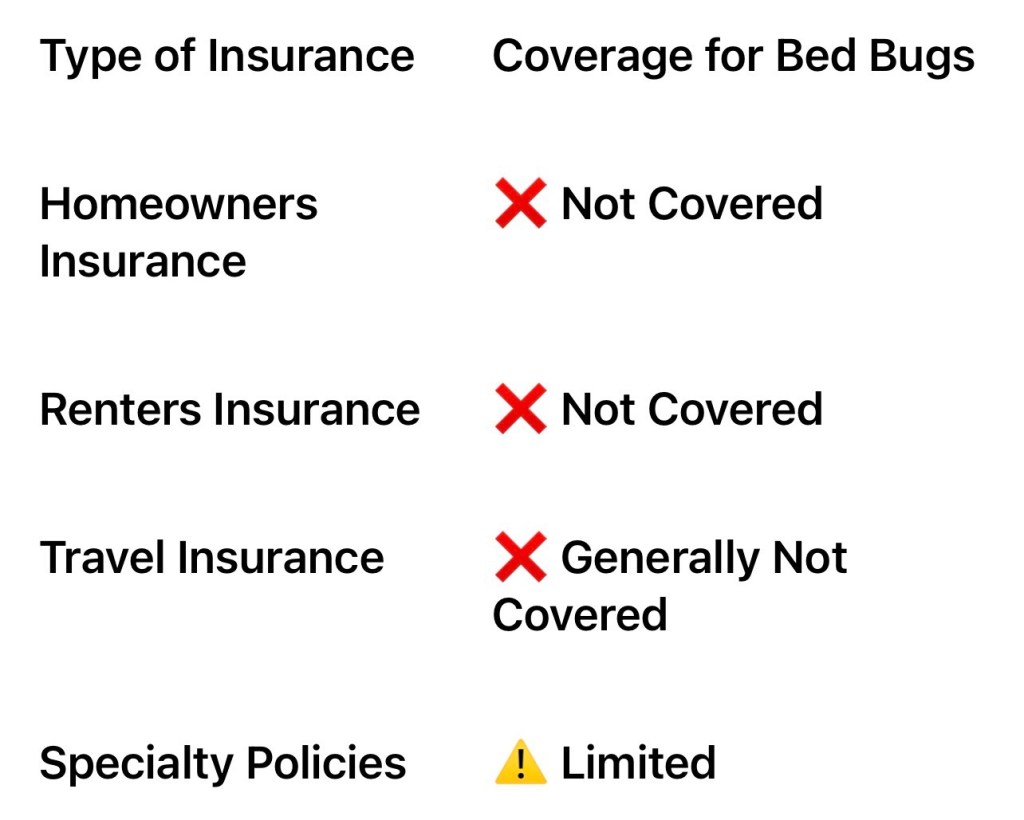
👉 In Maryland, just like the rest of the U.S.:
There is typically no insurance coverage for bed bugs.


🛑 Final Thought

Insurance won’t solve it.
Waiting makes it worse.
And guessing wrong can cost more than getting it checked.


📞 For Maryland Residents: Don’t Wait

If you suspect bed bugs in Baltimore, Montgomery County, Prince George’s County, or nearby areas:

  • Don’t rely on guesswork
  • Don’t wait for it to spread
  • Don’t assume insurance will cover it

✔️ Get a professional inspection
✔️ Confirm what you’re dealing with
✔️ Take action early

Call (410) 929-3420 to schedule your inspection, or click here to submit a request online.

Exploring Bed Bug Hacks – Separating Fact from Fiction

Dealing with a bed bug infestation can be a nightmare for homeowners. In the quest for solutions, many turn to various DIY methods or “bed bug hacks” found online. However, it’s essential to understand the efficacy of these methods before relying on them. In this blog, we’ll explore common bed bug hacks, delve into why they may not always live up to their promises, and provide insights into effective pest control strategies.

1. Freezing:
Placing infested items in the freezer to kill bed bugs and their eggs by exposing them to extreme cold temperatures.

While freezing can kill bed bugs, household freezers may not reach temperatures low enough or maintain consistent cold exposure to effectively eradicate all bed bugs and eggs.

2. Double-Sided Tape:
Applying double-sided tape around the legs of beds and furniture to trap bed bugs as they attempt to climb up.

Bed bugs are adept climbers and may find alternative paths to avoid the tape. Additionally, tape may not capture all bed bugs, especially those already residing on bedding or inside furniture.

3. Vacuuming:
Regularly vacuuming infested areas to physically remove bed bugs, eggs, and debris.

While vacuuming can remove some bed bugs, eggs, and debris, it’s not likely to eliminate an infestation entirely, especially if bed bugs are hiding in inaccessible areas or if the vacuum cleaner does not have a sealed bag to contain captured bugs.

4. Baking Soda:
Sprinkling baking soda around infested areas as it’s believed to dehydrate and kill bed bugs.

Baking soda may have limited effectiveness in killing bed bugs, as it primarily works through desiccation, which may not be sufficient to eliminate all bed bugs and their eggs.

5. Hair Dryer:
Using a hair dryer on high heat to target bed bugs and their eggs hiding in cracks and crevices.

While heat can kill bed bugs, a hair dryer may not produce temperatures high enough or maintain consistent heat to effectively eradicate bed bugs hiding in deep cracks and crevices. Additionally, using a hair dryer near bedding or flammable materials can pose safety risks.

6. Rubbing Alcohol:
Spraying rubbing alcohol directly on bed bugs to kill them on contact.

While rubbing alcohol can kill bed bugs on contact, it evaporates quickly and may not penetrate deep enough into hiding places to eliminate all bed bugs and eggs.

7. Dryer Sheets:
Placing dryer sheets in and around bedding and infested areas to repel bed bugs.

There is little scientific evidence to support the effectiveness of dryer sheets in repelling bed bugs or preventing infestations.

8. Silica Gel Packets:
Placing silica gel packets in infested areas to absorb moisture and dehydrate bed bugs.

While silica gel can absorb moisture, it’s unlikely to effectively dehydrate bed bugs or eliminate an infestation on its own. Additionally, silica gel packets typically contain small amounts of silica and may not have a significant impact on bed bugs.

9. Homemade Traps:
Creating DIY traps using household items like plastic containers, sugar, and yeast to attract and capture bed bugs.

DIY traps may capture some bed bugs, but they are unlikely to eliminate an infestation entirely. Bed bugs can easily avoid traps or find alternative routes to reach their hosts.

10. Essential Oil Sprays:
Spraying homemade essential oil mixtures on bedding and infested areas to repel bed bugs.

While some essential oils may have repellent properties, their effectiveness in deterring bed bugs is limited. Bed bugs can develop resistance to certain scents over time, rendering essential oil sprays ineffective as a long-term solution.

Although do-it-yourself bed bug hacks may offer apparent solutions, exercising caution is paramount. Grasping their limitations enables homeowners to make informed choices when combatting bed bug infestations. For thorough and enduring eradication, consulting pest control experts, equipped with comprehensive knowledge and resources, is often the optimal approach. If you suspect a bed bug infestation, reach out to ECO Bed Bug at 410.324.6223. ECO will work with you to develop a customized solution to address your needs.